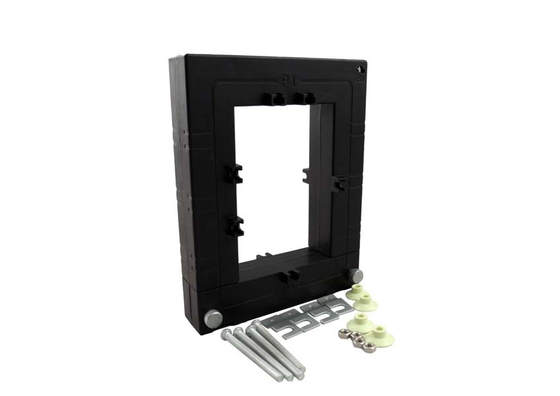
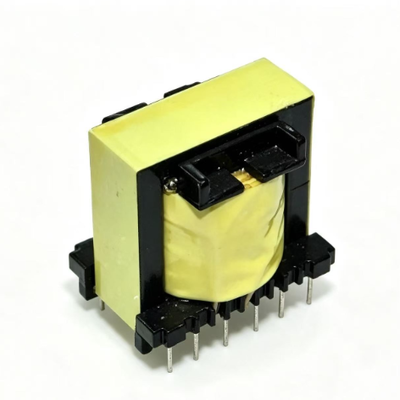
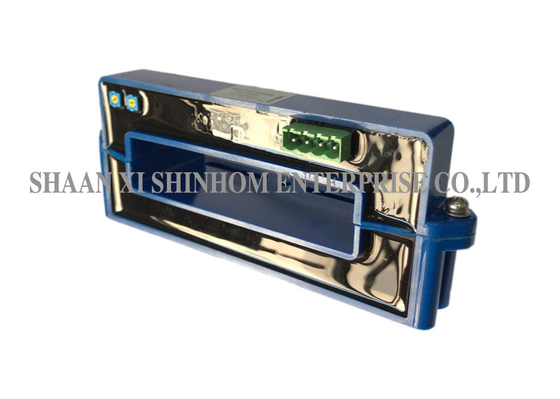
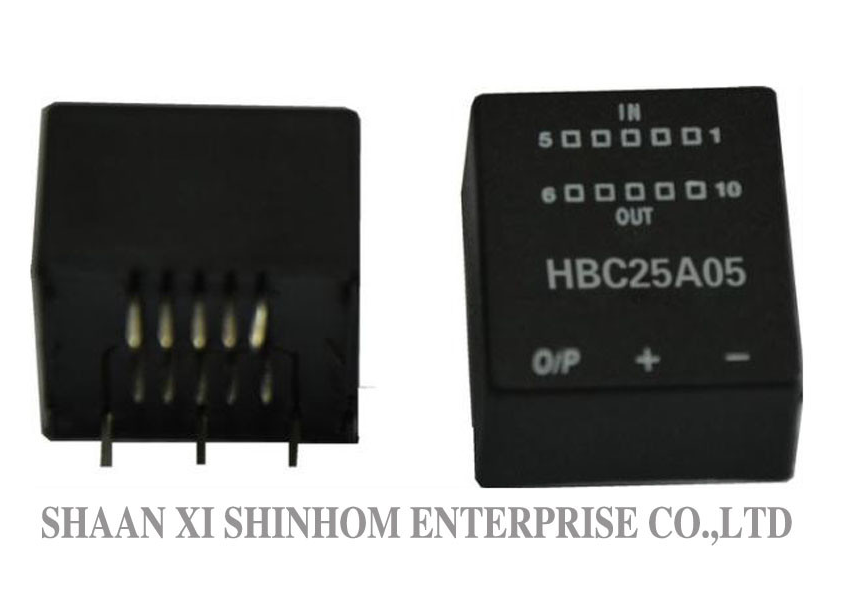
The HBC25A05 closed-loop Hall effect current sensor uses a closed-loop (compensation) principle, providing electrical isolation between the primary and secondary circuits. It accurately measures DC, AC, or pulse currents with a rated current of 25A and a turns ratio of 1:1000, with an output current of 25mA. The product has a supply voltage of +15V±5%. It offers high accuracy, excellent linearity, low temperature drift, and high external interference rejection. It features optimised response time, no insertion loss, low power consumption, and easy installation. It is widely used in inverters, AC/DC variable speed drives, UPS, switching power supplies, photovoltaic current sensing, new energy combiner box measurement, EV charging equipment current sensing, household appliance frequency conversion, and electromagnetic water heater current measurement.
Features
Applications
ELECTRICAL DATA:
| HBC25A05 | ||
|---|---|---|
| Rated input current | 25 | A |
| Test current range | 36 | A |
| Load impedance(@rated current) | 100~320(±15V) | Ω |
| Rated output current | 25±0.5% | mA |
| Supply voltage | ±15±5% | V |
| The supply consumes current statically 25℃ | ±12 | mA |
| Turns ratio | 1:1000 | |
| Zero offset current | ≤±0.15 | mA |
| Offset current Drift -40℃~+85℃ | ≤±0.60 | mA |
| Response time | <1 | µs |
| Linearity | ≤±0.2 | %FS |
| Insulation voltage 50HZ,1min | 2.5 | KV |
| di/dt | >50 | A/μs |
| Bandwidth(-3dB) | DC…150 | KHz |
| Sec winding resistance | 110 | Ω |
| Operating Temperature | -40~+85 | ℃ |
| Storage Temperature | -40~+105 | ℃ |
| Turns | Rated input current(Ipn) | Peak input current(Ip) | Rated output Current(mA) |
Turns ratio |
Pri Z mΩ |
Pri Lk uH |
|---|---|---|---|---|---|---|
| 1 | 25 | 50 | 25 | 1/1000 | 0.3 | 0.023 |
| 2 | 12 | 24 | 24 | 2/1000 | 1.1 | 0.09 |
| 3 | 8 | 16 | 24 | 3/1000 | 2.5 | 0.21 |
| 4 | 6 | 12 | 24 | 4/1000 | 4.4 | 0.37 |
| 5 | 5 | 10 | 25 | 5/1000 | 6.3 | 0.58 |
![]()
Notes: Product specifications can be customized
FAQ
Q: What does a turns ratio of 1:1000 mean?
A: A turns ratio of 1:1000 means the ratio of primary current to secondary compensation current is 1:1000. For example, a 25A primary current corresponds to a 25mA secondary compensation current, which can be output directly or converted to a voltage signal through a resistor.
Q: What are the advantages of no insertion loss and low power consumption?
A: No insertion loss ensures the circuit under test is not affected by the sensor, maintaining original circuit efficiency. Low power consumption reduces self-heating of the sensor, improves long-term stability, and reduces system energy consumption.
Q: How to apply for samples? What is the lead time?
A: You can submit a sample application through our website or email. Please provide your company information and target model. Samples are free of charge and will be shipped within 3-5 working days. Mass order lead time is generally 2-8 weeks.