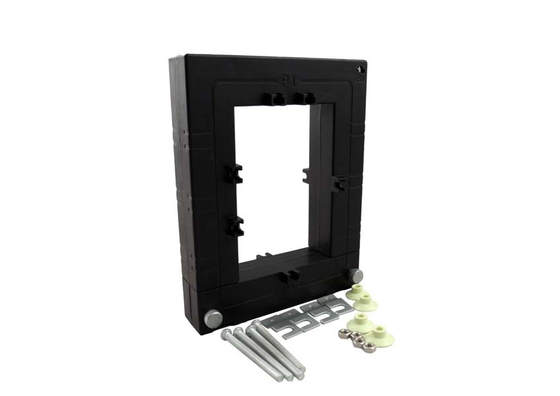
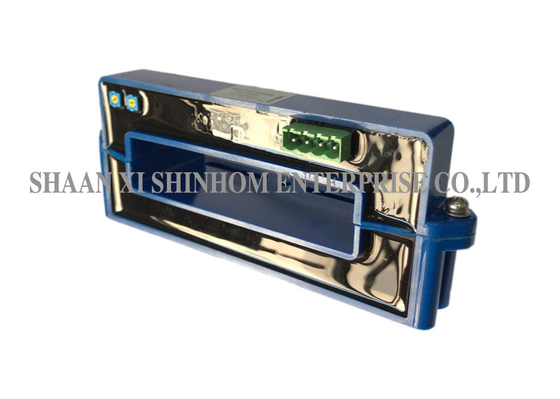
The HBC-DSR5 series closed-loop Hall effect current sensor uses the magnetic balance (closed-loop Hall effect) principle, providing electrical isolation between the primary and secondary circuits. It accurately measures DC, AC, pulse, and irregular currents. The product uses a single power supply with analogue voltage output and flexible assembly. It complies with UL94-V0 flame-retardant standards, is certified under the IATF16949 automotive quality management system, and is RoHS and CE certified. It is widely used in variable frequency drives, switching power supplies, UPS, converter equipment, industrial equipment (welding machines, textile machinery, etc.), photovoltaic solar protection, and wind power generation.
| HBC06DSR5 | HBC15DSR5 | HBC25DSR5 | HBC40DSR5 | ||
|---|---|---|---|---|---|
| Rated input current | 6 | 15 | 25 | 40 | A |
| Test current range | 19.2 | 48 | 80 | 120 | A |
| Turns ratio | 960 | 1200 | 2000 | 2000 | T |
| Rated output voltage | 0.625±0.5% | 0.625±0.5% | 0.625±0.5% | 0.625±0.5% | V |
| Supply voltage | +5±5% | V | |||
| Offset voltage | 2.5±0.5% | V | |||
| Reference voltage(VR) | 2.5±0.75% | V | |||
| Offset voltage Drift | ≤±0.5@-40~+85℃ | mV/℃ | |||
| Linearity | ≤±0.2 | %FS | |||
| Class | ≤±0.7 | % | |||
| di/dt | >50 | A/µS | |||
| Response time | <500 | nS | |||
| Bandwidth(-1db) | DC~200 | KHZ | |||
| Insulation voltage | 50HZ,1min,2.5 | KV | |||
| Operating Temperature | -40~+85 | ℃ | |||
| Storage Temperature | -40~+105 | ℃ | |||
![]()
Notes: Product specifications can be customized
Q: What is the difference between a magnetic balance Hall effect sensor and a standard Hall sensor?
A: A magnetic balance Hall effect sensor (closed-loop) uses a compensation coil to generate an opposing magnetic field, bringing the net magnetic flux in the core to zero. This provides higher accuracy and lower temperature drift. A standard open-loop Hall sensor directly amplifies the Hall voltage output, with a simpler structure but relatively lower accuracy.
Q: What types of current can this sensor measure?
A: It can measure DC, AC, pulse, and irregular currents, suitable for precise measurement of various complex current waveforms, meeting the requirements of variable frequency drives, inverters, and new energy applications.