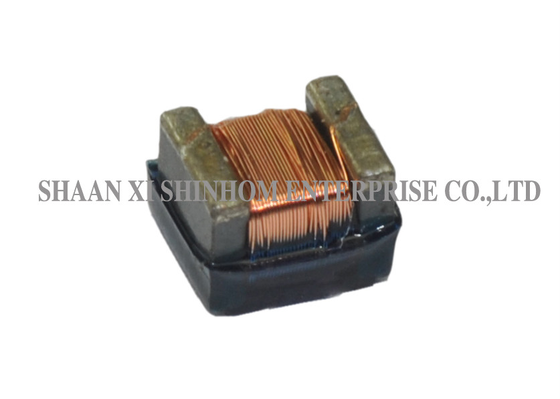
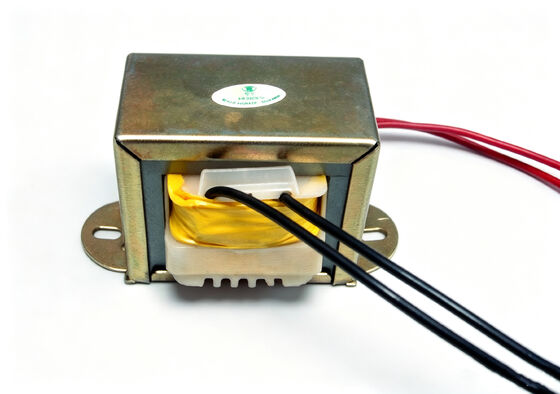
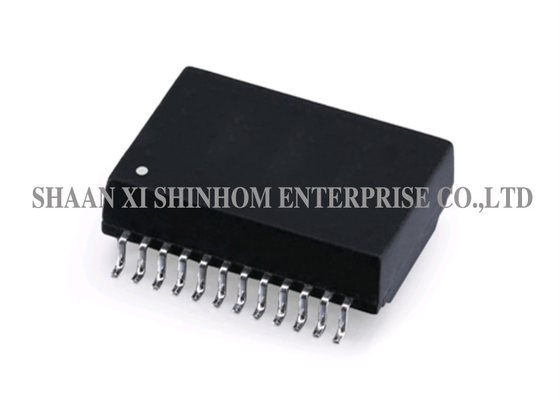
This 1:2 transmission line balun RF transformer is designed for broadband wireless communication and RF signal conversion applications. It uses a transmission line structure to simultaneously achieve 1:2 impedance transformation and balanced/unbalanced signal conversion.The product uses an SMD package with ultra-wide frequency coverage (5-1250MHz) , low main-line loss, and stable and reliable amplitude/phase balance performance across the wide frequency range.It is widely used in VHF/UHF receivers/transmitters, push-pull amplifiers, antenna systems, and broadband matching networks in RF applications. It is an ideal choice for impedance transformation and signal conversion in 75Ω systems.
| Parameter | Test Conditions | Units | Min | Typ | Max |
| Main line Loss(out1) | 5-1250MHz | dB | - | 0.5 | 1.5 |
| Main line Loss(out2) | 5-1250MHz | dB | - | 1.2 | 2.2 |
| Amplitude Balance | 5-1250MHz | dB | - | 0.6 | ±1.8 |
| Phase Balance | 5-1250MHz | Degrees | - | ±3.0 | ±7.0 |
| Input Return Loss | 5-1250MHz | dB | 8.0 | 17.0 | - |
![]()
![]()
![]()
![]()
Q: How do you establish long-term good business relationships with us?
A: We insist on high-quality products and fast delivery to ensure our customers win more projects. At the same time, we treat every customer as a friend and sincerely do business with them to build long-term friendship.
Q: How do you control quality?
A: We control product quality through incoming quality inspection (IQC) and 100% quality testing before packaging and shipment, ensuring every product meets specifications.
Q: What is the minimum order quantity (MOQ)?
A: The minimum order quantity varies by product type. The MOQ for standard products is typically 1000 pieces, while custom products may require a higher MOQ. Small trial orders can be negotiated. Please contact our sales team with your specific requirements.
Q: How do amplitude balance ±1.8dB and phase balance ±7° affect system performance across the 5-1250MHz wide frequency range?
A: Over an ultra-wide range of 10 octaves, these specifications ensure the differential signal maintains acceptable balance across the full band, effectively suppressing even-order harmonics and common-mode noise.
Q: How does the 1:2 transmission line balun achieve impedance transformation from 75Ω to 150Ω?
A: It uses the transmission line structure to convert a 75Ω single-ended signal to a 150Ω differential signal (or vice versa), suitable for matching a 75Ω system to a 150Ω differential load, such as the input stage of a push-pull amplifier.